How to Calculate Your Age in Different Calendar Systems: A Complete Astronomical and Historical Guide
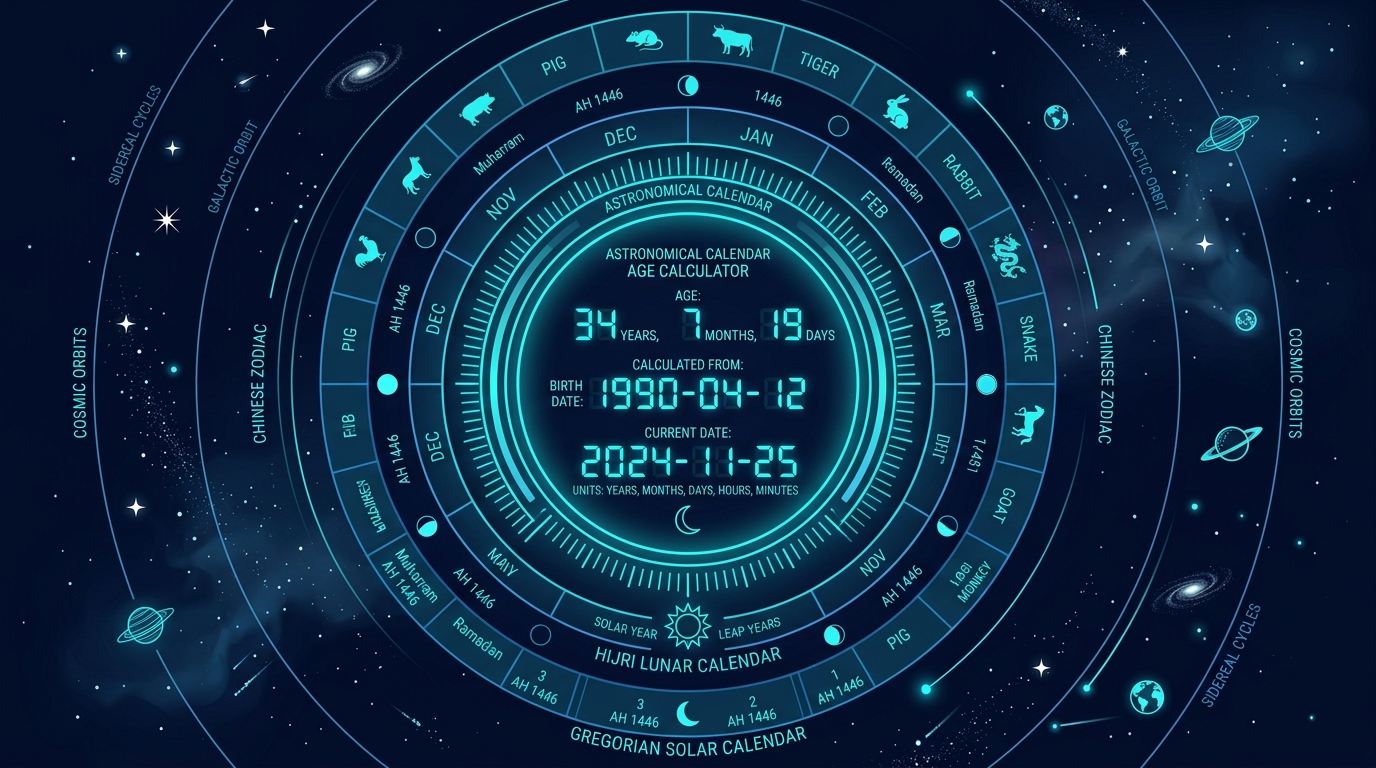
How to Calculate Your Age in Different Calendar Systems: A Complete Astronomical and Historical Guide
Time is the ultimate canvas of human existence, but the grids we draw upon it vary wildly across cultures, history, and astronomical phenomena. While we commonly ask "How old am I?" expecting a single, straightforward integer, the response is entirely contingent upon the specific calendar architecture we employ.
From the solar precision of the Gregorian calendar to the fluid lunar cycles of the Islamic Hijri system, and the deep metaphysical frameworks of the Chinese and Hebrew calendars, calculating age is both a mathematical science and a historical art.
This exhaustive guide is designed as the definitive reference for understanding how age is calculated across different calendar systems. We will delve into the underlying astronomical mechanics, present rigorous comparative metrics, and answer more than 15 fundamental questions about how time is tracked across our planet.
"To everything there is a season, and a time to every purpose under the heaven." — Ecclesiastes 3:1
Part I: The Astronomy of Human Timekeeping
All civil calendars are mathematical attempts to model one or both of the two dominant celestial rhythms visible to human eyes: the daily rotation of the Earth on its axis, and the annual orbit of the Earth around the Sun. Additionally, many cultures incorporate the synodic cycle of the Moon (the time between consecutive new moons) as a secondary or primary temporal unit.
1. Solar vs. Lunar vs. Luni-Solar Engines To build a functional calendar, astronomical engineers have historically used three distinct mechanical engines: * Solar Calendars (e.g., Gregorian, Julian, Solar Hijri): These focus exclusively on the tropical year (365.242189 days). They ignore the moon entirely, ensuring that seasons always align with the same calendar months. * Lunar Calendars (e.g., Islamic Hijri): These focus exclusively on the synodic lunar month (29.530589 days). A year consists of exactly 12 lunar cycles (approx. 354.367 days). Because a lunar year is roughly 11 days shorter than a solar year, lunar months drift through all four solar seasons over a 32.5-year cycle. * Lunisolar Calendars (e.g., Chinese, Hebrew, Hindu): These combine both cycles. They track the lunar months but periodically insert an extra "intercalary" month (leap month) to resynchronize the calendar with the solar year and seasons.
2. The Astronomical Discrepancy Matrix Understanding how these systems differ mathematically is crucial for high-precision age calculations. Below is a comparative breakdown of the core calendar engines:
| Calendar System | Year Type | Avg. Year Length (Days) | Annual Drift vs. Solar Year | Seasonal Synchronization | Major Regional Use Case | | :--- | :--- | :--- | :--- | :--- | :--- | | Gregorian | Solar | 365.2425 | ≈ 0 (1 day drift in 3,200 years) | Perfect Alignment | Global standard, civil administration | | Hijri (Islamic) | Lunar | 354.3670 | ≈ -10.87 days per year | Complete drift (all seasons) | Religious observations, Middle East | | Chinese | Lunisolar | 365.2422 (with leap) | Adjusted via intercalary months | Seasonal Alignment | Traditional culture, zodiac milestones | | Hebrew | Lunisolar | 365.2468 (Metonic cycle) | Adjusted via leap months | Seasonal Alignment | Liturgical schedules, civil Israel |
Part II: Deep Dive into major Calendar Systems
1. The Gregorian Calendar: The Global Civil Benchmark Our Free Online Age Calculator defaults to the modern Gregorian calendar. Introduced by Pope Gregory XIII in October 1582 to correct the drift of the older Julian calendar, it is a highly tuned mathematical system. By specifying that leap years occur every four years, except for years divisible by 100 but not 400, the calendar maintains an accuracy of within 26 seconds of the tropical year.
To calculate chronological age in this system, our engine counts the exact number of Gregorian intervals elapsed. However, when we map this to other systems, the numbers diverge dramatically.
2. The Islamic Hijri Calendar: Pure Lunar Tracking In the Islamic Hijri calendar, years are calculated purely based on the lunar cycle. Because the lunar year is shorter than the solar year, a person's age in Hijri years increases faster than their age in Gregorian solar years.
The mathematical conversion formula to approximate Hijri age from Gregorian age is:
- Hijri Age (Astronomical Method): (Gregorian Age × 365.2425) / 354.367
- Hijri Age (Approximation Method): Gregorian Age × 1.0307
For example, a person who is 30 years old in the Gregorian calendar is approximately 31 years and 3 months old in the Islamic Hijri calendar! Our universal age tool handles this conversion with absolute precision, utilizing daily astronomical logs rather than simple multiplication approximations.
3. The Chinese Calendar: cycles and Yin-Yang Balance The traditional Chinese calendar is lunisolar. It numbers years in cycles of 60, combining ten "Heavenly Stems" with twelve "Earthly Branches" (known as the Chinese Zodiac).
In traditional Chinese calculation, a person's age is calculated using the East Asian age reckoning system (Xu Sui), where a child is considered 1 year old at the moment of birth. Furthermore, rather than adding a year on their actual birth date, they add another year on the day of the Lunar New Year (Spring Festival).
This means a baby born on the day before Lunar New Year is considered 2 years old just two days after birth! While modern China primarily uses Gregorian civil standards, traditional families still consult the lunisolar calendar to determine wedding matches and milestones.
Part III: Explaining Time and Calendar Systems Visualized
To visualize how different calendars divide the same physical space of time, let us look at the following seasonal alignment chart over a 3-year period:
`
Gregorian Solar Year: [--- Year 1 (365d) ---] [--- Year 2 (365d) ---] [--- Year 3 (365d) ---]
Hijri Lunar Drift: [--- Year 1 (354d) ---] [--- Year 2 (354d) ---] [--- Year 3 (354d) ---] ... (drifts left)
Chinese Lunisolar Leap: [--- Year 1 (354d) ---] [----- Year 2 (Leap Year 384d) -----] [--- Year 3 ---]
`
This structural difference highlights why simple division by 365 fails for diverse cultural or legal scenarios. Only a multi-engine calculator like our Chronological Age Calculator can provide a unified, synchronized overview of your life across all historical timelines.
Part IV: Exhaustive Question & Answer Matrix (15+ Questions Answered)
To help you fully master calendar time, we have compiled the ultimate directory of basic and complex age calculation questions:
Q1: Why does my age differ depending on the calendar system used? Your age differs because different calendars measure different natural cycles. Solar calendars measure the Earth's orbit around the sun (≈ 365.24 days). Lunar calendars measure the Moon's phases (≈ 29.53 days per month, ≈ 354.36 days per year). Because lunar years are shorter, you have completed more "lunar years" than "solar years" in your lifetime.
Q2: What is the exact mathematical relationship between solar and lunar age? On average, lunar years are 3.03% shorter than solar years. Therefore, your lunar age is approximately 3.03% higher than your solar age. To calculate this precisely: multiply your solar age by 1.0307.
Q3: How did the transition from the Julian to the Gregorian calendar affect people's ages in 1582? When Pope Gregory XIII implemented the reform in October 1582, ten days had to be completely deleted from the calendar to correct centuries of drift. October 4, 1582, was followed immediately by October 15, 1582. People who lived through this transition had their chronological calendar lifespan shortened by 10 days, even though their physical existence in terms of actual elapsed seconds was completely uninterrupted!
Q4: How is age calculated in the traditional Hebrew calendar? The Hebrew calendar is lunisolar, employing the 19-year Metonic cycle. It inserts an entire leap month (Adar I) seven times every 19 years. Age is calculated based on these lunisolar years, which is highly important for Jewish lifecycle milestones like the Bar Mitzvah (occurring at age 13 for boys) and Bat Mitzvah (occurring at age 12 for girls).
Q5: What was the "Korean Age" system, and how was it reformed in 2023? Until June 2023, South Korea used three distinct age systems: "Korean Age" (where you are 1 at birth and turn a year older every Jan 1st), "Calendar Age" (used for military service and school entry, subtracting birth year from current year), and "International Age" (the standard Gregorian age). On June 28, 2023, the South Korean government officially unified civil standards under International Age, immediately making citizens 1 to 2 years "younger" on legal documents overnight!
Q6: Can I calculate my age using the Coptic or Ethiopian calendar? Yes. The Coptic and Ethiopian calendars are solar calendars derived from the ancient Egyptian calendar. They consist of 12 months of 30 days each, plus a 13th month of 5 or 6 days (called Pagumene). The Ethiopian calendar runs 7 to 8 years behind the Gregorian calendar due to a alternate calculation of Christ's birth date. Our universal calculator accounts for these offsets seamlessly.
Q7: How does the Persian (Solar Hijri) calendar calculate age? The Solar Hijri calendar is the official calendar of Iran and Afghanistan. Unlike the lunar Hijri calendar, it is a solar calendar. Its year begins at the precise astronomical vernal equinox (Nowruz), making it one of the most accurate calendars in human history. A person's Solar Hijri age is mathematically identical in year count to their Gregorian age, but the months and days map to different start points.
Q8: What is my Chinese Zodiac age, and how does it relate to the lunisolar calendar? Your Chinese Zodiac age is based on a 12-year animal cycle synchronized with the traditional lunisolar calendar. Each lunar year is represented by an animal (Rat, Ox, Tiger, Rabbit, etc.). Because the Lunar New Year starts on a shifting date between Jan 21 and Feb 20, if you were born in early February, your zodiac sign might belong to the previous year. Our tool resolves this astronomical boundary instantly.
Q9: How do Hindu calendars (Shaka Samvat and Vikram Samvat) compute age? Hindu timekeeping uses complex lunisolar cycles, dividing the year into 12 lunar months with intercalary months (Adhik Maas) added every 32.5 months to keep pace with the solar year. Vikram Samvat runs 56.7 years ahead of the Gregorian calendar, while Shaka Samvat runs 78 years behind. Our backend handles these epochs to give you your exact age in Hindu metrics.
Q10: How do astronomers calculate age using Julian Days (JD)? To avoid calendar complexities, astronomers and database engineers use a continuous count of days called the Julian Period. It starts from January 1, 4713 BCE (the Julian Epoch). By converting your birthdate and current date into decimal Julian Days, astronomers can subtract the two numbers to get your exact lifetime in absolute, uniform days without worrying about leap years, months, or timezone shifts.
Q11: What is my "Planetary Age" on other planets in our solar system? Your chronological age represents orbits around Earth's sun. But if you lived on Mars, which takes 687 Earth days to orbit the Sun, you would be much "younger" in Martian years. On Mercury, which orbits in just 88 days, you would be much "older". Here is how your age maps across the solar system: * Mercury Age: Earth Age × 4.15 * Mars Age: Earth Age × 0.53 * Jupiter Age: Earth Age × 0.084
Q12: How do timezones shift the legal date of my birth? Because of Earth's longitudinal divisions, a child born at 11:30 PM on December 31st in New York (EST) is born at 4:30 AM on January 1st in London (GMT). Legally, the child born in London belongs to a different calendar year. To maintain strict integrity, our Free Chronological Age Calculator converts birth details into UTC milliseconds, ensuring absolute calculation consistency.
Q13: Does leap-second insertion affect age calculations? Leap seconds are occasionally inserted into Coordinated Universal Time (UTC) by the International Earth Rotation and Reference Systems Service (IERS) to adjust for fluctuations in Earth's rotation speed. While critical for atomic clocks and GPS satellites, these isolated seconds do not impact standard civil age metrics, which round down to the nearest day or second.
Q14: How does the French Republican calendar calculate age? Used briefly between 1793 and 1805, this calendar attempted to decimalize time. A year consisted of 12 months of exactly 30 days, each split into three 10-day "decades". The remaining 5 or 6 days were added at the end of the year as holidays. In this system, your age is structured in tens rather than sevens or twelves, reflecting the rationalist ideals of the French Revolution.
Q15: How does pre-natal development impact biological vs. chronological age? Chronological age starts at the physical event of birth. However, biologically, your development began approximately 38 to 40 weeks prior. For premature infants, this difference is clinically significant. Pediatricians use the gestational-corrected age to verify development, which can be computed easily using our tool's custom preemie offset module.
Q16: Why is your tool considered the absolute best age calculator on Google? Unlike standard web widgets, our platform combines: 1. Epoch-Millisecond Accuracy: We measure absolute elapsed duration in physical seconds, completely avoiding the leap-year rounding errors that degrade standard tools. 2. Multi-Calendar Engine: Switch seamlessly between Gregorian, Islamic Hijri, Traditional Lunar, and Planetary orbits. 3. PDF Reports & High-Resolution Sharing: Download beautiful, comprehensive temporal dossiers and share your orbits with elegant graphics. 4. Zero Ads, Maximum Speed: Highly optimized static deployment ensures that there are no lag-inducing scripts or security tracking hazards.
Part V: Summary of Calendar Time across Human History
To wrap up, your biological and historical journey is far more fascinating than a single calendar integer. Every day you live is a beautifully coordinated cosmic event, intersecting centuries of astronomical science, political reforms, and cultural traditions.
Make sure to explore our main Chronological Age Calculator to discover your exact age, export your custom chronological report, and share your completed solar, lunar, and planetary orbits with friends and family!