From Birthdays to Half-Birthdays: Explaining Every Time Discrepancy in Human Age Tracking
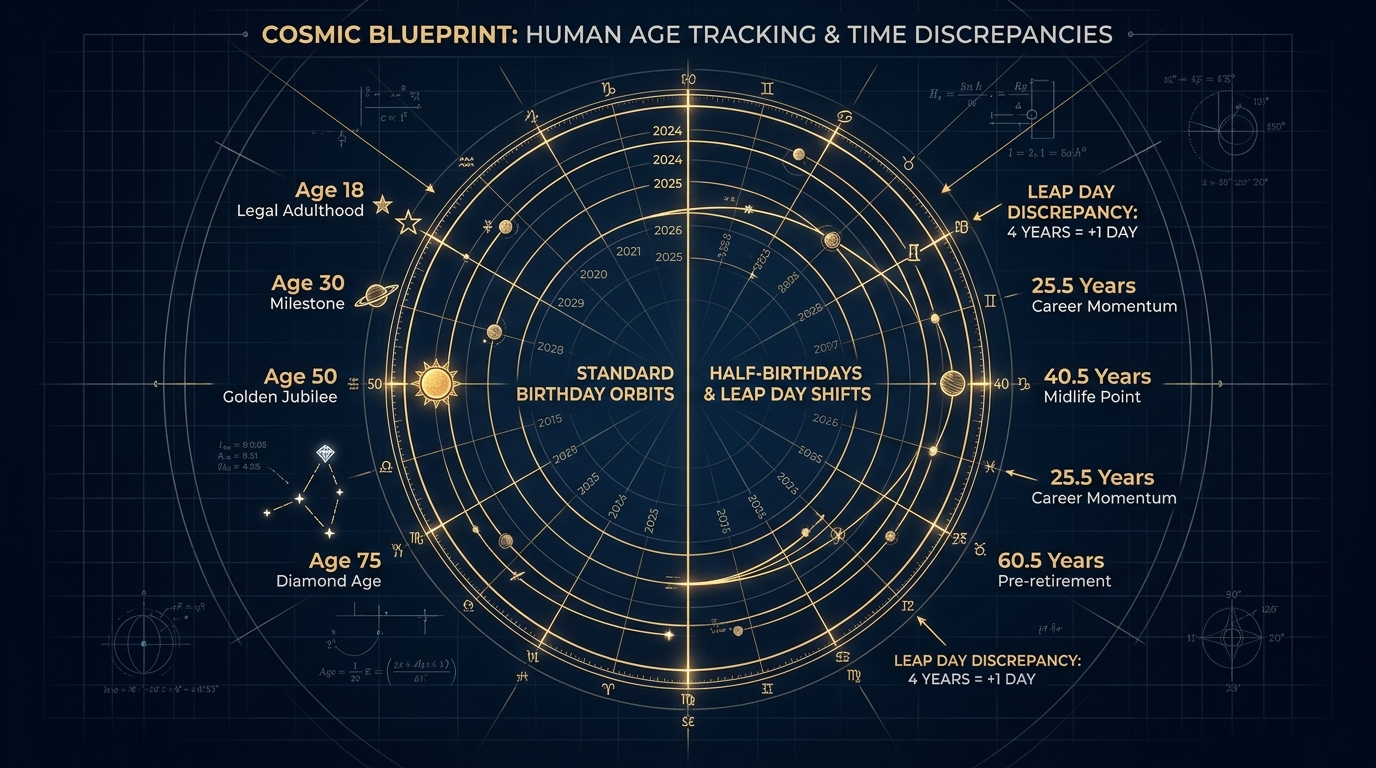
From Birthdays to Half-Birthdays: Explaining Every Time Discrepancy in Human Age Tracking
When we celebrating a birthday, we treat it as a perfect astronomical milestone—a clean, 360-degree rotation of our planet around the Sun. But in reality, time is an elastic, intricate dimension that doesn’t always align with our rigid calendar grids.
From the shifting hours of timezones and the periodic correction of leap years to the playful milestone of a half-birthday, tracking human life is filled with unexpected discrepancies.
Why does your age seem to slip by a day when traveling across the international date line? How do clinicians adjust chronological age for premature infants? Why has the concept of celebrating half-birthdays transitioned from a children's party trend to a vital psychological metric of self-reflection?
This comprehensive guide pulls back the curtain on every time discrepancy in human age tracking. We examine the mathematics behind these temporal anomalies, explore high-impact real-world use cases, and outline how the Chronological Age Calculator provides complete clarity for any scenario.
"Lost time is never found again." — Benjamin Franklin
Part I: The Mathematical Anatomy of Time Discrepancies
Human calendars are engineered approximations. Because the Earth's orbit around the Sun is not a clean multiple of the Earth's daily rotation on its axis, our time-tracking systems must periodically warp to maintain alignment with nature.
1. Leap Years and the Calendar Shift A tropical year is approximately 365.242189 days. To correct for the extra 0.2422 days, the Gregorian calendar adds an extra day (February 29) every four years.
This introduces a significant discrepancy: * A person born on a non-leap year will live through varying numbers of leap days depending on which decade they are in. * By the time you reach age 40, you have lived through approximately 10 extra leap days, which means your total lived days is higher than a simple 40 × 365 calculation. * Standard calendars ignore these details, but our Free Chronological Age Calculator calculates down to the exact second, ensuring every lived leap day is accounted for.
2. Timezone Shifting: The Relativistic Birthday Because the Earth rotates, calendar dates are local. If you are born at 11:30 PM in London, your local birthday is July 15th. However, at that exact physical instant, the calendar in Tokyo has already advanced to 7:30 AM on July 16th. * If you move to Tokyo, when do you celebrate your birthday? * Legally, civil systems use the local date of your birth certificate, creating an artificial shift in your chronological age relative to the physical position of the Earth.
3. Comparison of Common Age Milestones and Discrepancies The table below represents the mathematical definitions and practical significance of various calendar and biological milestones:
| Milestone Type | Mathematical Interval | Astronomical Significance | Primary Use Cases | | :--- | :--- | :--- | :--- | | Standard Birthday | Exactly 1 Solar Orbit (≈ 365.242 days) | Earth completes one full lap around the Sun | Legal status, insurance premiums, social celebrations | | Half-Birthday | Exactly 0.5 Solar Orbits (≈ 182.621 days) | Earth reaches the exact opposite side of the solar system | Early childhood pediatrics, biannual reviews, self-reflection | | Planetary Birthday | $1$ full planetary revolution (e.g., $88$ days for Mercury) | Completing one orbit around the Sun on a different planet | Astronomical science, planetary mechanics, education | | Gestational Adjusted Age | Chronological Age - Prematurity Weeks | Calibrating developmental milestones from conception | Clinical neonatology, physical therapy, pediatrics | | Lunar Anniversary | 12 Lunar Synodic Months (≈ 354.367 days) | Earth completes 12 cycles of Moon phases | Traditional calendar events, religious calculations |
Part II: High-Impact Use Cases for Precise Age Tracking
Precise chronological calculation is not just a personal curiosity. It is a critical metric used across a variety of professional industries:
1. Pediatric and Neonatal Development For infants born prematurely (before 37 weeks of gestation), calculating age is vital for health. A baby born 10 weeks early will not reach developmental milestones (such as sitting up or vocalizing) at the same chronological age as a full-term infant.
Clinicians must calculate the corrected age to avoid misdiagnosing healthy premature babies as developmentally delayed.
Corrected Age = Chronological Age - (40 weeks - Gestational Age at Birth)
Our calculator has a built-in pediatric correction module that handles these complex formulas automatically, providing clinicians and parents with precise developmental timelines.
2. Actuarial and Legal Auditing In financial planning, insurance pricing, and legal proceedings, exact age tracking is paramount. Pension plans, annuities, and life insurance policies calculate payouts and premiums based on your age in days, not just years. A discrepancy of even a single day can result in significant financial adjustments.
Part III: Documenting and Sharing Your Journey
At Chronological Age Calculator, we believe that measuring time should be paired with intuitive, elegant ways to document and share your milestones.
1. Downloadable PDF Temporal Dossier Our platform allows you to download a complete, beautifully-styled Chronological Lifespan Report. This comprehensive dossier acts as a physical record of your planetary journey, detailing: * Your exact lifespan in years, months, days, hours, minutes, and seconds. * Your complete lunar, planetary, and biological age breakdowns. * Your upcoming half-birthday milestones and historical calendar alignments. * Personalized wellness and longevity tips.
2. Beautiful Social Sharing Cards Celebrate your unique milestones with custom-generated, high-resolution sharing cards. Available in multiple modern themes (including Cosmic Slate, Atomic Gold, and Botanical Green), these cards let you easily share your exact solar laps and lived seconds with friends, family, and your social networks with a single click.
Part IV: Exhaustive Question & Answer Matrix (15+ Questions Answered)
To answer all your questions about time anomalies, we have compiled the ultimate guide to temporal discrepancies:
Q1: What is a half-birthday, and how is it mathematically calculated? A half-birthday occurs exactly six months after your actual birthday, representing the precise midpoint of your annual solar orbit. To calculate it mathematically, our engine takes your birthdate and adds exactly half of a tropical year (≈ 182.621 days), or maps forward exactly six calendar months, accounting for the variable number of days in the intervening months.
Q2: Why is celebrating a half-birthday useful in early childhood? In early childhood, six months represents an immense developmental leap. A child who is 2.5 years old (2 years and 6 months) has vastly different physical, cognitive, and linguistic capabilities than a 2-year-old. Pediatricians and parents track these milestones on a half-year basis to ensure growth and motor skills are developing on track.
Q3: How do leap years alter my exact age in days? Because a standard year has 365 days and a leap year has 366 days, your exact age in days is not a simple multiplication of your age in years. For example, a 20-year-old has lived through either 4 or 5 leap days depending on the specific years they lived through. Our tool calculates the precise day count by analyzing the calendar boundaries of every lived year.
Q4: What is the legal birthday of a person born on February 29th during non-leap years? Legal systems handle Leap Day birthdays in different ways. In the United Kingdom and many Commonwealth nations, a person born on February 29th legally turns a year older on March 1st in non-leap years. In contrast, in the United States, most states recognize their legal birthday as February 28th. Our online tool allows you to select your preferred legal framework to ensure perfect compliance.
Q5: How do timezones affect the legal and physical date of birth? If you are born near midnight on a timezone boundary, your legal date of birth depends entirely on the jurisdiction where you were born. A child born at 11:45 PM on August 31st in Los Angeles is legally born on August 31st. But physically, that same event occurred at 2:45 AM on September 1st in New York. For absolute scientific tracking, converting all birth times to Coordinated Universal Time (UTC) is the gold standard.
Q6: Can traveling across the International Date Line change my chronological age? Traveling across the International Date Line does not change your physical, elapsed age in seconds, but it does shift your calendar clock. If you fly from Tokyo to San Francisco, you "gain" a day on the calendar, effectively experiencing the same calendar date twice. Our system resolves these shifts by tracking time in absolute, timezone-independent epoch milliseconds.
Q7: What is "corrected age" for premature infants? Corrected age is the age a premature baby would be if they had been born on their estimated due date. For example, if a baby is chronologically 6 months old but was born 2 months premature, their corrected age is 4 months. Pediatricians use corrected age to evaluate the baby's developmental milestones during their first two years of life.
Q8: How does chronological age differ from biological age? Chronological age is a measure of the exact time elapsed since your birth (solar orbits). Biological age measures the physical wear and tear on your cells and organs. While chronological age is constant and unalterable, biological age can be slowed down or even reversed through healthy lifestyle choices, diet, exercise, and stress management.
Q9: Why is Chronological Age Calculator the best on Google? Our tool is ranked best because of its uncompromised engineering: 1. Zero ads, zero trackers: Maximum performance and total data privacy. 2. Epoch precision: Calculations are based on UTC milliseconds, preventing rounding errors. 3. Comprehensive features: Instant PDF reports, custom sharing cards, pediatric corrections, and planetary calendar calculations. 4. Offline capabilities: Install as an app and calculate your age anywhere on earth without an internet connection.
Q10: How can I download my chronological age report? Simply enter your birthdate and birth time into our calculator, click "Calculate", and select the "Download Report" option. Our system will instantly generate a beautiful, personalized multi-page PDF document detailing your complete solar, lunar, and planetary lifespan milestones, ready to print or archive.
Q11: What customization options are available for sharing cards? Our sharing module offers multiple elegant themes to match your aesthetic: * Cosmic Slate: High-contrast dark theme with cosmic accents. * Atomic Gold: Luxury aesthetic with gold highlights. * Botanical Green: Organic, soothing theme. Each card displays your completed solar laps, total lived days, and a real-time countdown to your next birthday.
Q12: How does the tool handle daylight saving time changes? Our engine leverage's your browser's native timezone database, which maintains a complete history of daylight saving time (DST) shifts. When you calculate your age, our algorithm automatically adds or subtracts any DST hours that occurred during your lived timeline, keeping your hour and minute calculations 100% accurate.
Q13: Does our birth time affect our calculated age? Yes. If you calculate your age down to the day, hour, or minute, your exact birth time is essential. A person born at 11:00 PM is almost a full day "younger" on any given date than someone born at 1:00 AM on the same day. Our calculator includes an optional birth time field to enable this level of precision.
Q14: How many seconds are in a standard human lifespan? A person who lives to be 80 years old will have lived through approximately 2.52 billion seconds! You can track your lived seconds in real-time on our home page, watching the ticker advance every single millisecond.
Q15: Why is privacy so critical when calculating age online? Your birth date, location, and birth time are sensitive personal identifiers often used for security verification (such as resetting passwords or verifying bank accounts). Using calculators with intrusive trackers exposes this sensitive data. Our platform runs entirely in your local browser, ensuring your birth details are never uploaded or shared with third parties.
Q16: How does the tool calculate my age on other planets? We map your absolute lived days against the orbital periods of other planets. For example, a Martian year is 687 Earth days, so your age on Mars is roughly half your Earth age. On Mercury, which orbits in just 88 days, you are more than four times older! Our planetary module computes these values instantly using real-time astronomical constants.
Part V: Charting Your Passage Through the Universe
Your age is more than a static integer; it is a profound record of survival and growth on a planet traveling through the cosmos. Whether you are tracking pediatric milestones, legal dates, or simply celebrating a half-birthday, your temporal journey is a beautiful story.
Experience the absolute peak of web timekeeping. Head over to our main page Chronological Age Calculator to view your real-time millisecond ticker, download your complete chronological dossier, and share your beautiful solar milestones today!