The Cosmic Clock: How Our Lives Sync with Earth and Space Orbits
The Cosmic Clock: How Our Lives Sync with Earth and Space Orbits
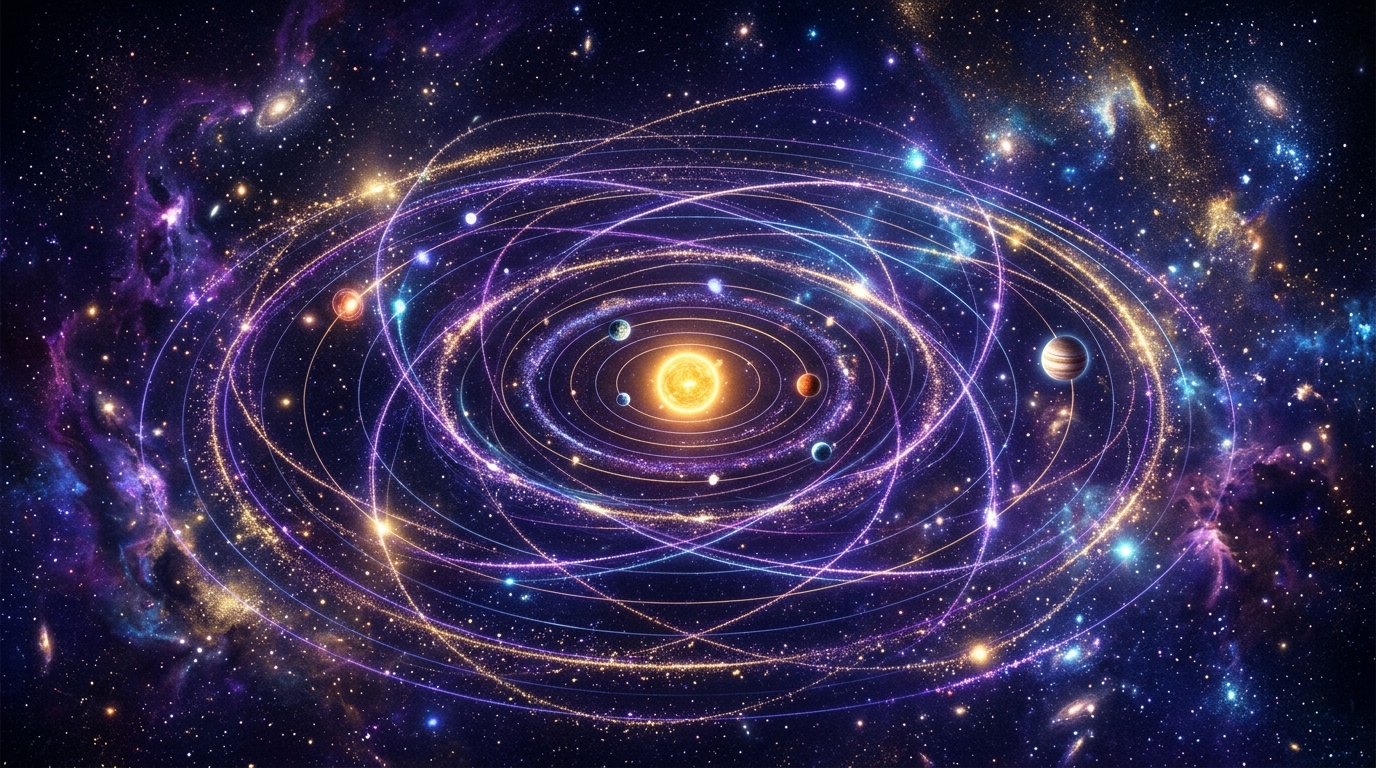
For the entirety of human existence, we have measured our lives by arbitrary calendar squares, digital display tickers, and the rhythmic chiming of grandfather clocks. Yet, these mechanical intervals are merely artificial proxies for a much more profound, immersive, and awe-inspiring reality: we are celestial passengers riding a planetary spaceship, perpetually locked in a multi-layered orbital choreography.
When you calculate your chronological age, you are not merely tallying up elapsed seconds or counting pages ripped from a desk calendar. You are counting completed heliocentric revolutions. You are measuring the physical distance your physical body has traveled through the vacuum of interstellar space.
In this deep exploration, we dismantle the artificial divide between human time and astronomical time. We analyze the intricate gravitational strings that tie our cellular physiology, our sleep-wake patterns, and even our psychological perception of self to the cosmic orbits of the Earth, Moon, and planets.
Part I: The Heliocentric Velocity of Human Aging
The next time you celebrate a birthday, consider the astonishing physical reality of what that milestone represents. To complete a single year—one full orbit of the Earth around the Sun—you do not sit static. You are hurtling through the cosmic void at an average orbital speed of 29.78 kilometers per second (roughly 67,000 miles per hour).
By the time you reach your 30th birthday, you have traveled approximately 28.2 billion kilometers in space since the exact second of your birth. This is not a closed circle. Because the Sun itself is also traveling around the Galactic Center of the Milky Way at an estimated 230 kilometers per second, your actual path through the universe is a majestic, infinite helix.
This helical transit means you never occupy the same spatial coordinate twice. Every second of your life is lived in entirely brand-new cosmic territory. Your age is a metric of galactic migration, a physical accumulation of distance traversed through an ever-expanding space-time continuum.
The Physics of Our Galactic Transit * Earth's Heliocentric Speed: ~29.78 km/s * Solar System's Galactic Speed: ~230 km/s * A 25-Year-Old's Traversed Distance: ~23.5 billion kilometers relative to the Sun, and a staggering 181 billion kilometers relative to the Galactic Center!
This massive macro-scale physical translocation occurs completely beneath our sensory awareness, cushioned by the protective cocoon of Earth's atmosphere and the equivalence principle of general relativity. Yet, our bodies are deeply synchronized with these cycles, responding to subtle shifts in gravity, radiation, and light that accompany our cosmic journey.
Part II: The Circalunar Tides of Human Biology
While our annual anniversaries mark our grand solar orbits, our day-to-day and month-to-month existences are governed by a secondary, deeply intimate cosmic clock: the Moon.
For billions of years, the Moon has orbited the Earth in a rhythmic dance of light and shadow, defining the Synodic Month of 29.53 days. This cycle of lunar phases—from the dark, quiet mystery of the New Moon to the high-contrast brilliance of the Full Moon—has left an indelible mark on the evolutionary blueprint of earthly life.
Historically, scientists dismissed lunar influences on human biology as folklore or superstition. However, modern chronobiological research has begun to uncover subtle, profound correlations between human physiology and lunar rhythms, known as circalunar cycles.
Sleep Latency and the Synodic Loop A landmark study published in Current Biology demonstrated that during the nights leading up to a Full Moon, human sleep patterns undergo a measurable shift. Specifically, researchers observed: 1. A 20-minute reduction in total sleep duration. 2. A 5-minute increase in sleep latency (the time it takes to fall asleep). 3. A significant drop in deep-sleep delta-wave activity recorded via EEG.
Astonishingly, these subjects were studied in highly controlled, light-tight laboratory environments with absolutely zero visual cues or awareness of the current lunar phase. This indicates that our brains possess an internal circalunar clock, an ancient evolutionary relic synchronized with the gravitational and electromagnetic tides of our satellite.
Part III: Circadian Clocks and Solar Synchronization
On the micro-scale, our daily survival depends on our synchronization with a single, highly local cosmic event: the rotation of the Earth on its axis, relative to our parent star. This 24-hour cycle of light and dark has birthed the circadian system, an intricate network of biological clocks operating within every single cell of our bodies.
At the apex of this network sits the Suprachiasmatic Nucleus (SCN), a tiny cluster of approximately 20,000 neurons located in the hypothalamus of the brain. The SCN acts as our master clock, receiving direct photic feedback from specialized photosensitive ganglion cells in the retina.
This master clock regulates the rise and fall of vital hormones: * Melatonin: The hormone of darkness and cellular repair, which peaks in the middle of the night to facilitate sleep and deep-tissue regeneration. * Cortisol: The hormone of alertness and metabolic activity, which surges in the early morning hours to prepare the body for the physical demands of a new diurnal period.
When we disconnect from this cosmic rhythm—through artificial blue light exposure, chronic sleep deprivation, or rapid trans-meridian travel—we suffer from circadian desynchrony. This state of being "out of sync" with the Earth's rotation is not merely a cause of fatigue; it is a primary driver of long-term metabolic, cardiovascular, and immunological decline.
Calculating your exact age in days, hours, and minutes highlights just how many times your SCN has coordinated this delicate biochemical ballet. Each day of your life represents a completed axial spin, a perfect biological response to a planet spinning in the cosmic dark.
Part IV: Planetary Transits and the Tapestry of Time
Beyond the Earth and the Moon, we are surrounded by a choir of sister planets, each singing in its own orbital frequency. As these worlds complete their respective journeys around the Sun, they define alternative temporal scales that expand our understanding of longevity.
On Mercury, a year lasts a mere 88 Earth days. If you lived on this sun-scorched rock, you would celebrate your birthday four times as often. On Neptune, however, a single orbit takes a colossal 164.8 Earth years—meaning a human being will rarely, if ever, witness a single Neptunian anniversary in their lifetime.
By looking at our age through these planetary lenses, we cultivate a deep, philosophical detachment from our parochial 365-day mindset. We realize that "time" is not a rigid, universal constant, but a flexible, relative canvas shaped by gravity, mass, and orbital radius.
| Planet | Orbital Period (Earth Days/Years) | Your Age in Planetary Years (if 30 Earth Years old) | | :--- | :--- | :--- | | Mercury | 87.97 days | 124.5 Years | | Venus | 224.70 days | 48.7 Years | | Earth | 365.25 days | 30.0 Years | | Mars | 1.88 years | 15.9 Years | | Jupiter | 11.86 years | 2.5 Years | | Saturn | 29.45 years | 1.0 Year |
When we calculate our Mars or Jupiter years, we are expanding our awareness to the broader architecture of the Solar System. We are recognizing that our biological journey is happening within a grand celestial machinery, a clock of colossal proportions.
Conclusion: Living with Orbital Mindfulness
Modern society has severed our connection to the sky. We live in climate-controlled boxes, insulated from the changing of the seasons, bathed in artificial light that masks the night sky, governed by digital notifications that ignore the sun's position. We have become chronologically displaced, forgetting that we are part of an infinite cosmic system.
Embracing Orbital Mindfulness means reclaiming this connection. It is the conscious practice of aligning our daily awareness with the astronomical movements of our planet. When you look at an exact chronological calculator, do not see a reminder of aging or decay. Instead, see a beautifully precise telemetry log of your journey through space-time.
You are an active traveler. You have completed dozens of laps around a brilliant G-type star, ridden waves of lunar gravitational pull, and adapted your biochemistry to the rhythmic spinning of a blue marble. By keeping this celestial perspective alive, we transform the simple act of aging into a grand, epic adventure—an ongoing, beautiful voyage across the cosmic ocean.