The DNA Epigenetic Clock: Why Your Biological Age Matters More Than Your Birth Year
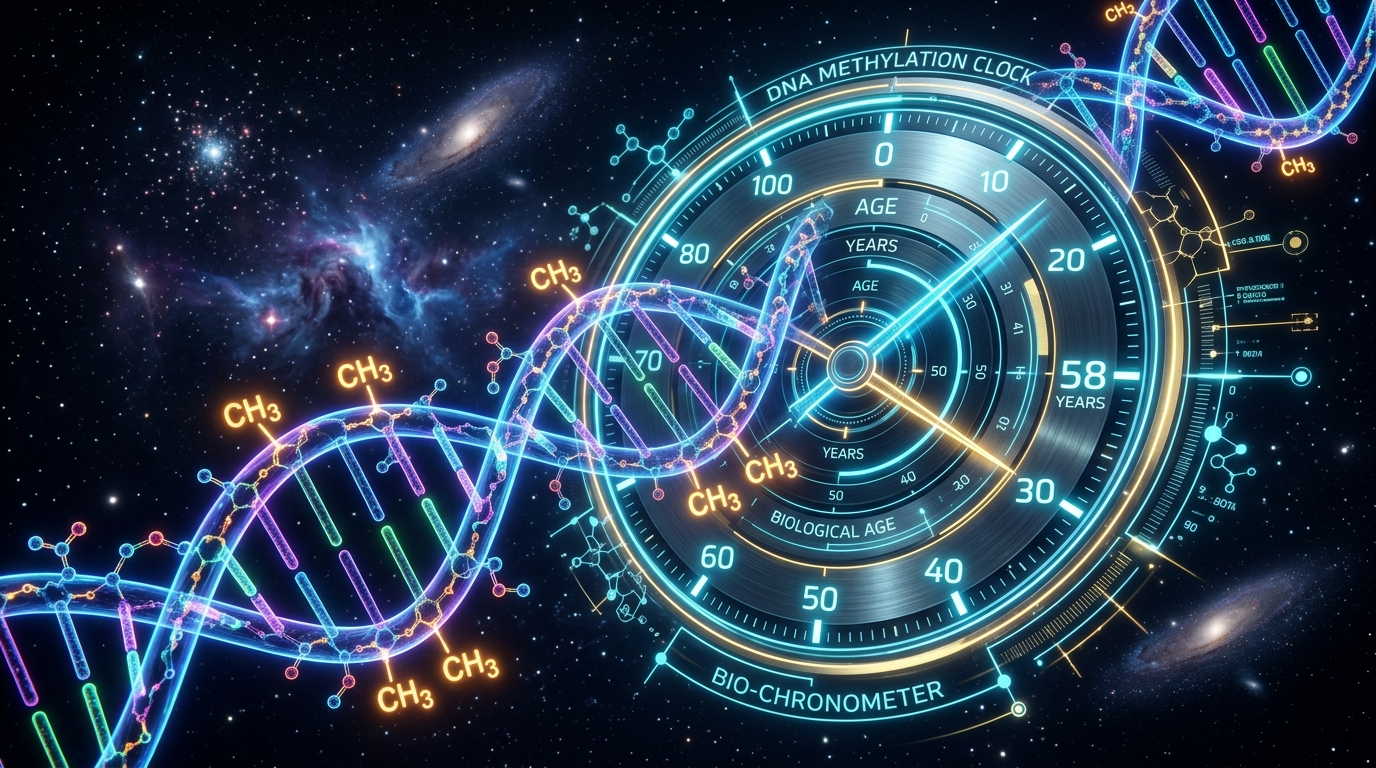
The DNA Epigenetic Clock: Why Your Biological Age Matters More Than Your Birth Year
We have all met individuals who seem completely untethered from their calendar years. A sixty-year-old who runs marathons with the physiological agility of a person half their age, or a thirty-year-old suffering from the chronic joint degeneration and fatigue typically reserved for late retirement. For centuries, humanity has conceptualized aging as a rigid, monolithic march along a linear timeline—measured strictly by how many times our planet has completed its orbit around the sun.
But our cells do not count solar revolutions. They do not consult calendars, and they do not care about leap years. Within the microscopic architecture of our cells, a completely different clock is ticking. This is the biological clock—a dynamic, fluid, and highly personal indicator of your body's true functional decline or preservation. While your chronological age is a fixed historical record of your time on Earth, your biological age represents your actual physical vitality, systemic inflammation, and risk of mortality.
In this deep, scientific exploration, we will unpack the revolution of the DNA Epigenetic Clock. We will discover how researchers have learned to read our genomic history, why biological age calculations have eclipsed chronological dates in clinical medicine, and how you can utilize our advanced Chronological Age Calculator to compare your birth milestones with your molecular vitality.
Part I: The Fundamental Divergence of Two Timelines
To truly comprehend the science of longevity, we must first establish a universal truth that governs all biological systems:
"Aging is not a uniform process of systemic decay, but rather a highly variable, localized program of cumulative cellular adaptation and epigenomic drift."
This universal truth means that two infants born on the exact same second in the exact same hospital can, fifty years later, possess biological profiles that are decades apart. One might have the cellular integrity of a 38-year-old, while the other exhibits the vascular and cognitive decline of a 65-year-old.
Defining the Terms: Chronological vs. Biological
- Chronological Age: This is the literal, mathematical tally of days, months, and years that have elapsed since your birth. It is a retrospective calculation based entirely on astronomical cycles. It is highly reliable for legal purposes, such as driver's licenses and pensions, but offers surprisingly poor resolution regarding an individual's actual physiological status. If you need to calculate your exact chronological age down to the precise hour or minute, our Chronological Age Calculator provides the standard computational framework.
- Biological Age: This is a physiological estimate of your functional capacity, cellular integrity, and vulnerability to disease. It represents how far along you are on your personal journey of senescence. Unlike chronological age, biological age is malleable. It can accelerate due to chronic stress, poor nutrition, and toxic exposures, or it can decelerate—and potentially even reverse—through strategic lifestyle modifications, caloric restriction, and cutting-edge longevity therapies.
Part II: The Epigenetic Landscape and the Methylation Hourglass
To understand how scientists measure this invisible timeline, we must zoom in past our organs, past our tissues, and straight into our double-helix DNA.
Our genome is often compared to a blueprint. It is a static set of instructions that remains virtually identical throughout our entire lives. However, a blueprint is useless unless someone decides which walls to build, which doors to open, and which lights to turn on. This regulatory system is the epigenome—a complex network of chemical tags placed on top of our DNA that dictates which genes are actively translated into proteins and which are silenced.
The most precise and heavily researched epigenetic tag is DNA Methylation. This occurs when tiny chemical clusters, known as methyl groups (consisting of one carbon atom and three hydrogen atoms), attach themselves to specific sites along our DNA strand, particularly at "CpG islands"—regions where a cytosine nucleotide is immediately followed by a guanine nucleotide.
When a methyl group binds to a gene's promoter region, it acts like a microscopic dimmer switch, turning down or completely silencing that gene's expression. As we age, our cells undergo a predictable, highly systematic pattern of methyl tag gains and losses. Some critical, protective genes (like tumor suppressors) gradually become hyper-methylated and silenced, while other genes that promote systemic inflammation become hypo-methylated and overactive. This systematic shift is what we refer to as Epigenic Drift.
The famous biologist Conrad Waddington famously compared the epigenome to a marble rolling down a rugged, grooved hill—the "epigenetic landscape." At the top of the hill (youth), the marble has infinite potential paths. As it rolls down (aging), the grooves narrow and become deep, limiting the cell's potential and locking it into a state of progressive exhaustion.
Part III: Horvath's Clock and the Birth of Molecular Chronometry
For decades, biologists searched for reliable "biomarkers of aging"—physiological measurements that could accurately predict how long a person had left to live. They measured telomere length, grip strength, pulmonary capacity, and fasting glucose. While helpful, none of these metrics possessed the predictive precision required for clinical diagnostics.
Everything changed in 2013 when Dr. Steve Horvath, a geneticist and biostatistician at UCLA, published a groundbreaking paper. Horvath analyzed thousands of DNA methylation datasets across dozens of human tissue types. Using advanced machine learning algorithms, he identified a specific set of 353 CpG methylation sites that behaved as a highly unified, universal clock.
By measuring the methylation state of these 353 specific genomic addresses, Horvath's algorithm could predict an individual's chronological age with an astonishing margin of error of less than 3.6 years across almost any human tissue, including blood, brain tissue, saliva, and liver cells.
DNA Methylation vs. Chronological Aging Trajectories
Comparing standard astronomical baseline with optimized biological longevity and accelerated stress curves.
When the methylation clock matches your chronological age exactly, you are aging at a standard biological rate. However, if your calculated epigenetic age is, say, 8 years older than your astronomical birth record, you are in a state of epigenetic age acceleration. This acceleration is a powerful, independent predictor of all-cause mortality, cancer, cardiovascular disease, and cognitive decline.
Since Horvath's pioneering discovery, researchers have developed "second-generation" epigenetic clocks:
- PhenoAge: Developed by Morgan Levine, this clock incorporates clinical biomarkers of systemic inflammation, organ function, and metabolic health alongside methylation data, making it even more predictive of physical morbidity than Horvath's original model.
- GrimAge: Named after the Grim Reaper, this highly specialized clock measures epigenetic changes associated with plasma proteins and smoking history. It is currently the gold standard for predicting exact mortality risk and overall health span.
Part IV: Biomarkers of Aging: Mapping the Cellular Landscape
While DNA methylation remains the single most precise molecular clock, biological aging is a multi-systemic phenomenon. Clinical longevity researchers look at a cluster of biological markers to paint a complete portrait of an individual's physiological timeline.
The table below breaks down the key biomarkers utilized in modern clinical diagnostics to calculate your cellular age:
| Biomarker Category | Primary Molecular Target | Clinical Significance | Method of Measurement | | :--- | :--- | :--- | :--- | | Epigenetics | CpG DNA Methylation | Tracks global epigenetic drift, gene silencing, and cellular exhaustion rates. | Next-Generation DNA Sequencing | | Genomics | Telomere Length Decay | Measures the protective caps on chromosomes; shortens with successive cell divisions. | Quantitative PCR (qPCR) | | Inflammatory | High-Sensitivity CRP & IL-6 | Tracks "inflammaging"—the chronic, sterile, low-grade inflammation that drives heart disease. | Serum Blood Draw Analysis | | Metabolic | HbA1c & Fasting Insulin | Measures glycemic control, advanced glycation end-products (AGEs), and insulin resistance. | Plasma Biomarker Panel | | Proteomics | Advanced Glycation Markers | Tracks the accumulation of damaged, misfolded, or cross-linked proteins in tissues. | Mass Spectrometry | | Physiological | Heart Rate Variability (HRV) | Measures autonomic nervous system balance, systemic stress resilience, and cardiorespiratory age. | Continuous Electrocardiography |
Part V: Can We Stop and Reverse the Biological Clock?
Perhaps the most exhilarating aspect of biological age research is that, unlike chronological age, biological age is plastic. You cannot change the date of your birth, but you can absolutely change the chemical markings on your DNA.
In a landmark clinical trial led by Dr. Kara Fitzgerald in 2021, participants underwent an 8-week intervention protocol focused on diet, sleep, exercise, and specific phytonutrient supplements designed to support optimal DNA methylation. The results were astounding: in just two months, the participants reduced their biological age by an average of 1.96 years compared to the control group.
The Longevity Protocol:decoding Methylation Support
How do we optimize our epigenetic switches and support healthy biological age deceleration? Science points to several accessible, highly evidence-based pillars:
- Methyl Donor Nutrients: To place healthy methyl tags on our DNA, our body requires a constant supply of methyl donors. These are obtained through foods rich in folate (dark leafy greens), vitamin B12 (grass-fed meats, shellfish), choline (egg yolks), and betaine (beets).
- Epigenetic Modulators: Compounds like epigallocatechin gallate (EGCG) from green tea, curcumin from turmeric, and sulforaphane from cruciferous vegetables acts as natural inhibitors of DNA methyltransferases, helping prevent the hyper-methylation of protective longevity genes.
- Caloric Restriction and Fasting: Periodic nutrient deprivation triggers a cellular cleaning process called autophagy. This clears away accumulated senescent cells—the so-called "zombie cells" that secrete inflammatory molecules and accelerate tissue aging.
- Autonomic Balance: Chronic cortisol elevation (stress) is a massive accelerant of epigenetic aging. Prioritizing deep sleep, meditation, and high heart rate variability (HRV) directly protects the genomic structure from stress-induced methylation damage.
As the legendary poet and essayist Ralph Waldo Emerson once wisely noted:
"The complete measure of a man is not how many years he has lived, but how much life, vitality, and awareness he has packed into those years."
This classic sentiment resonates perfectly with modern biogerontology. It is not the quantity of solar orbits that determines our story, but the quality of our cellular transcription.