Gravity, Velocity, and Cosmic Chronology: Why Your Age on Mars, Jupiter, or a Near-Light Speed Vessel Breaks Standard Chronological Arithmetic
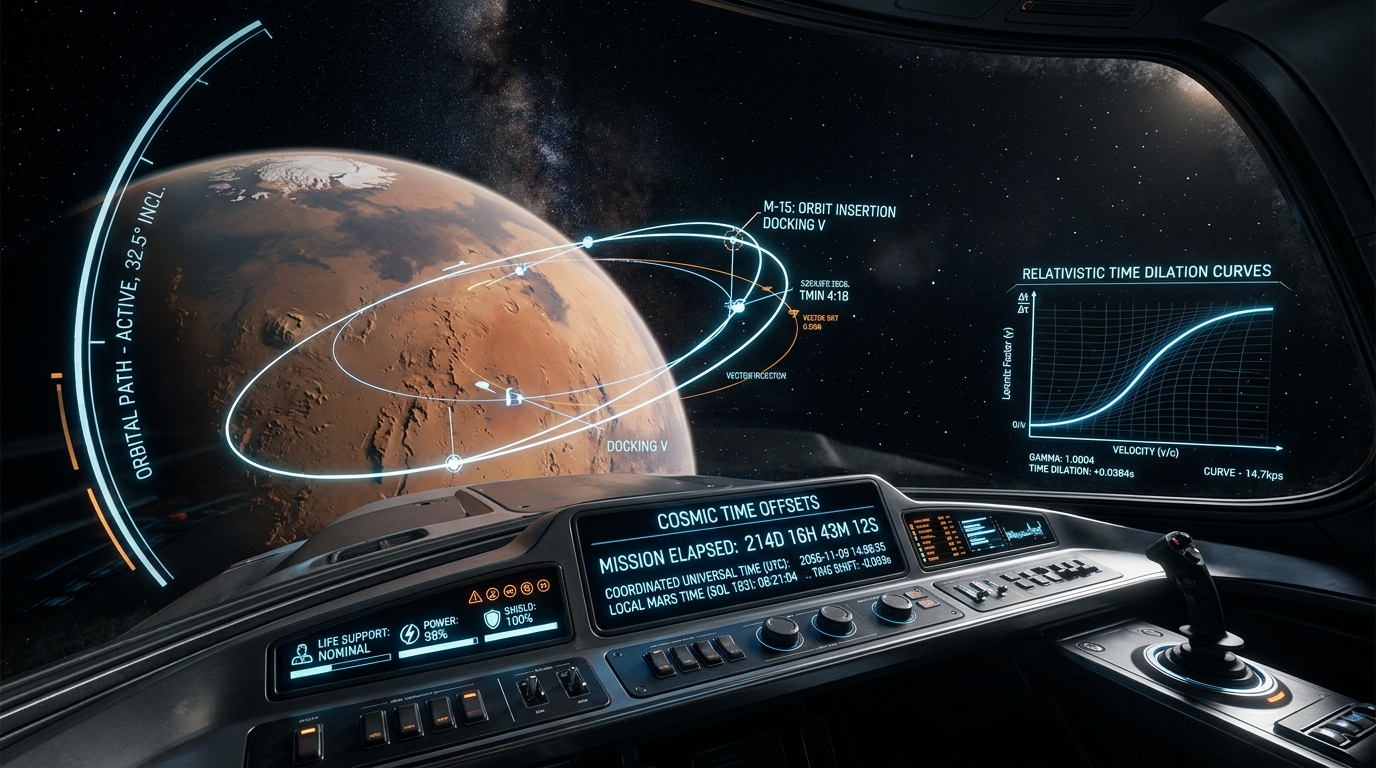
Gravity, Velocity, and Cosmic Chronology: Why Your Age on Mars, Jupiter, or a Near-Light Speed Vessel Breaks Standard Chronological Arithmetic
When you load the Chronological Age Calculator on your screen, it requests a simple inputs: day, month, year, and perhaps the exact hour of your arrival into the world. Within milliseconds, the system outputs your exact age down to the second. It is a stunning, beautifully optimized calculation.
Yet, this calculation relies on a deeply comfortable, local illusion—the silent assumption that a second is a second, everywhere, for everyone, across the entire expanse of the cosmos.
We live in a low-gravity, low-velocity pocket of the universe. Because of this, we are insulated from the mind-bending reality of modern physics: time is not a universal background river flowing at a constant speed. Instead, time is a dynamic, malleable dimension that stretches, squeezes, and warps depending on how fast you are moving and how deep you are resting inside a gravitational well.
As humankind stands on the precipice of becoming an interplanetary species, our traditional frameworks for tracking chronological age are about to collapse. An infant born on Earth on the exact same day as an infant born in a dome on Mars will not be the same age after a decade—neither in terms of orbital years nor in terms of literal, molecular, atomic seconds elapsed.
In this comprehensive scientific thesis, we will explore the mathematics of cosmic timekeeping, calculate the precise drift of human age across the Solar System, analyze the extreme effects of high-velocity space travel, and demonstrate why future chronological calculators must evolve into relativistic coordinate transformations to remain accurate.
The Universal Truth of Time
Before we dive into the complex mathematics of Einsteinian relativity, we must acknowledge a fundamental, inescapable truth of the cosmos:
"No matter how fast you travel or how strong the gravitational field you occupy, your local experience of the present moment always ticks at exactly one second per second—yet the universe around you will record your journey differently."
This means that while your personal biological clock never feels accelerated or decelerated, your physical, chronological age is entirely dependent on your relative frame of reference.
Part I: The Foundations of Relativistic Time Dilation
To understand why a space-faring civilization cannot rely on simple calendar subtraction, we must turn to Albert Einstein’s theories of Special Relativity (1905) and General Relativity (1915). Einstein shattered the Newtonian paradigm of absolute space and absolute time, proving instead that space and time are fused into a dynamic, four-dimensional fabric called spacetime.
Time dilation occurs in two distinct environments: 1. Kinematic Time Dilation (Velocity): Time slows down for objects moving at high speeds relative to a stationary observer. 2. Gravitational Time Dilation (Mass): Time runs slower in regions of stronger gravitational fields (closer to massive bodies like planets, stars, or black holes).
1. Kinematic Time Dilation (Special Relativity)
When an object moves through space, its motion is shared between the three dimensions of space and the single dimension of time. The faster an object moves through space, the slower it must travel through time to preserve the constant speed of light ($c$).
The mathematical relationship is governed by the Lorentz Factor ($gamma$):
$$gamma = \frac{1}{sqrt{1 - \frac{v^2}{c^2}}}$$
The dilated time interval ($Delta t'$) experienced by a moving clock, relative to the proper time interval ($Delta t$) of a stationary observer, is calculated as:
$$Delta t' = Delta t sqrt{1 - \frac{v^2}{c^2}}$$
Where: * $v$ is the relative velocity of the moving body. * $c$ is the speed of light in a vacuum ($approx 299,792,458\text{ meters per second}$).
At everyday human velocities (such as flying in a commercial jetliner at $250\text{ m/s}$), the value of $v^2/c^2$ is so microscopically tiny that the time difference is practically unmeasurable without ultra-precise cesium atomic clocks. However, as velocities approach a significant fraction of the speed of light (relativistic speeds), time dilation curves exponentially upward toward infinity.
2. Gravitational Time Dilation (General Relativity)
General Relativity reveals that gravity is not a physical pulling force, but rather the geometric curvature of spacetime caused by mass and energy. The deeper you are in a "gravity well," the more spacetime is compressed, and the slower clocks tick relative to an observer in flat, empty space.
For a non-rotating, spherically symmetric mass, the gravitational time dilation is calculated using the Schwarzschild Metric:
$$t_f = t_0 sqrt{1 - \frac{2GM}{r c^2}} = t_0 sqrt{1 - \frac{r_s}{r}}$$
Where: * $t_f$ is the coordinate time in a region infinitely far from the mass (flat spacetime). * $t_0$ is the proper time experienced closer to the massive body. * $G$ is the gravitational constant ($6.67430 \times 10^{-11}\text{ m}^3\text{ kg}^{-1}\text{ s}^{-2}$). * $M$ is the mass of the gravity-inducing body (e.g., Earth, Mars, Jupiter). * $r$ is the radial distance from the center of the mass. * $r_s$ is the Schwarzschild radius of the body ($2GM/c^2$).
Because of gravitational time dilation, your head technically ages slightly faster than your feet, as your feet are closer to the center of the Earth's gravity well. Over a 70-year lifetime, this difference amounts to approximately 90 billionths of a second—an imperceptible fraction, but a highly real physical phenomenon.
Part II: The Interplanetary Drift: Earth vs. Mars
To bring this physics down to a practical engineering scale, let us examine the immediate future of human colonization: the planet Mars.
Suppose two twins are born at the exact same instant. One remains on Earth, while the other is transported to a research habitat on Mars. How does their chronological age compare after one Earth decade (10 Earth years)?
1. The Astronomical (Orbital) Age Difference
First, we must distinguish between "orbital years" and "absolute elapsed time." * Earth's Orbital Year: Approximately 365.24219 days. * Mars's Orbital Year: Approximately 686.98 Earth days (or 1.88 Earth years).
If we define "age" purely by the number of orbital transits around the Sun: * The Earth twin will celebrate their 10th birthday. * The Mars twin, tracking their local solar cycles (called Sols), will only have experienced 5.31 Martian years of age!
This creates an immediate record-keeping challenge. If the Mars twin states they are "5 years old," they have actually lived almost as long as a 10-year-old on Earth. To maintain accurate medical and developmental records, pediatricians on Mars must use highly optimized algorithms to convert Martian Sols back to Earth-standard metrics, similar to the preterm birth adjustments analyzed in The Science of Pediatric Corrections.
2. The Absolute Relativistic Time Drift
Even if we completely ignore orbital years and measure age purely in absolute SI seconds elapsed on atomic clocks, relativity introduces a permanent, physical drift between the twins.
Mars is smaller and less massive than Earth: * Earth Mass ($M_E$): $5.972 \times 10^{24}\text{ kg}$ * Mars Mass ($M_M$): $6.39 \times 10^{23}\text{ kg}$ (about 10.7% of Earth's mass) * Earth Radius ($R_E$): $6,371\text{ km}$ * Mars Radius ($R_M$): $3,389\text{ km}$
Because Earth is significantly more massive, its gravitational well is much deeper. Consequently, time runs slower on Earth than it does on Mars.
Using the General Relativity formula for gravitational time dilation, we can calculate the relative rate of time passage.
For Earth: $$sqrt{1 - \frac{2G M_E}{R_E c^2}} approx 1 - 6.96 \times 10^{-10}$$
For Mars: $$sqrt{1 - \frac{2G M_M}{R_M c^2}} approx 1 - 1.40 \times 10^{-10}$$
Subtracting the two values: $$\text{Relative Drift Rate} = (6.96 \times 10^{-10}) - (1.40 \times 10^{-10}) = 5.56 \times 10^{-10}$$
This means that for every second that passes on Earth, an extra $0.556\text{ nanoseconds}$ passes on Mars.
Let us scale this up over a human lifetime of 80 Earth years:
$$\text{Drift per Year} = 5.56 \times 10^{-10} \times 365.24 \times 86,400\text{ seconds} approx 0.0175\text{ seconds (17.5 milliseconds)}$$
$$\text{Drift over 80 Years} = 0.0175 \times 80 approx 1.40\text{ seconds}$$
By the time the Mars twin is an old man, he is physically, molecularly, and chronologically 1.4 seconds older than his identical twin on Earth. His cells have undergone 1.4 seconds worth of extra metabolic activity, his brain has processed 1.4 seconds of extra thoughts, and his atomic clocks are 1.4 seconds ahead.
This interplanetary discrepancy is not a software glitch—it is a physical law of the universe.
Part III: Gravity and Time Passage Across the Solar System
To fully grasp the range of temporal relativity, let us expand our calculations to other planetary bodies, stations, and gravity fields across our solar neighborhood.
The following table demonstrates the comparative rate of time passage on various celestial bodies relative to a hypothetical observer sitting in flat, empty space (zero gravity, zero velocity):
| Planetary / Stellar Body | Surface Gravity ($m/s^2$) | Mass relative to Earth | Gravitational Time Dilation (Seconds lost per Earth Year) | Microscopic Aging Rate vs. Flat Space | | :--- | :--- | :--- | :--- | :--- | | Interstellar Void (Flat Space)| 0.00 | 0.00 | 0.0000 Seconds | 100.0000000% (Baseline) | | The Moon | 1.62 | 0.012 | -0.0011 Seconds | 99.9999999% | | Mars | 3.71 | 0.107 | -0.0044 Seconds | 99.9999998% | | Earth | 9.81 | 1.000 | -0.0220 Seconds | 99.9999993% | | Jupiter (Cloud Tops) | 24.79 | 317.800 | -0.6310 Seconds | 99.9999800% | | The Sun (Surface) | 274.00 | 333,000.000 | -662.4000 Seconds | 99.9979000% | | Neutron Star (Extreme) | $approx 2 \times 10^{12}$ | $approx 500,000$ (highly dense)| $approx 9,460,000$ Seconds | $approx 70.0000000%$ |
Part IV: High-Velocity Kinematic Age Shift: The Twin Paradox
While gravitational time dilation produces small, millisecond-level drifts over human lifetimes, kinematic time dilation (speed) can create massive, multi-decade age gaps. This is famously illustrated by the Twin Paradox.
Imagine a scenario where Twin A remains on Earth (stationary observer) while Twin B boards a futuristic, fusion-powered exploration vessel capable of traveling at 90% the speed of light ($0.9c$).
Twin B travels to a star system located 4.5 light-years away, immediately turns around, and returns to Earth at the same velocity.
The Math of the Journey (From Earth's Perspective)
For Twin A on Earth, the distance traveled by the spaceship is $2 \times 4.5 = 9\text{ light-years}$. At a velocity of $0.9c$, the total travel time is:
$$\text{Time Elapsed on Earth} = \frac{\text{Distance}}{\text{Velocity}} = \frac{9\text{ light-years}}{0.9c} = 10\text{ Years}$$
For Twin A, 10 full years have passed on their calendar.
The Math of the Journey (From the Spaceship's Perspective)
Because Twin B is traveling at relativistic speeds, they experience significant kinematic time dilation. We calculate their experienced proper time using the Special Relativity formula:
$$\text{Time Elapsed on Ship} = 10\text{ Years} \times sqrt{1 - (0.9)^2}$$
$$\text{Time Elapsed on Ship} = 10 \times sqrt{1 - 0.81} = 10 \times sqrt{0.19} approx 10 \times 0.4359 approx 4.36\text{ Years}$$
When Twin B steps off the spaceship and reunites with Twin A: * Twin A has aged 10.00 years. * Twin B has aged only 4.36 years.
This is not an illusion. Twin B is physically and biologically 5.64 years younger than their twin. If they both input their identical birthdates into our current Chronological Age Calculator, the software would fail to show the truth because it does not account for the velocity coordinates of Twin B's trajectory.
To resolve this, future chronological calculations will require entering worldline integrals—the complete path of an individual through four-dimensional spacetime.
DNA Methylation vs. Chronological Aging Trajectories
Comparing standard astronomical baseline with optimized biological longevity and accelerated stress curves.
Part V: Biological vs. Relativistic Aging Clocks
An interesting question arises: Does time dilation affect biological aging in the same way it affects mechanical and atomic clocks?
The answer is an absolute yes.
Time dilation is not a mechanical lag in clock gears; it is an alteration of the space-time fabric itself. All physical processes—the decay of subatomic particles, the vibrations of quartz crystals, the rate of chemical and enzymatic reactions, the replication of DNA, and the beating of a human heart—slow down by the exact same Lorentz factor.
However, even in relativistic space travel, individuals will still experience the divergence between chronological age (elapsed physical seconds) and biological age (cellular wear and tear).
A traveler on a high-stress, microgravity vessel might experience time dilation that makes them chronologically younger than their Earth peers, but the radiation exposure and lack of gravity might accelerate their cellular epigenetic degradation. This fascinating interplay between cellular health and physical time metrics is explored deeply in our investigation of The DNA Epigenetic Clock: Biological vs. Chronological Timelines.
Part VI: The Engineering Challenge of Relativistic Time Synchronization
We do not have to wait for starships or Mars bases to experience relativity. Our modern digital networks already grapple with these temporal warps every day.
The most prominent real-world example is the Global Positioning System (GPS). GPS satellites orbit approximately $20,200\text{ km}$ above the Earth, traveling at speeds of about $14,000\text{ km/h}$ ($3.9\text{ km/s}$).
Because of their motion, special relativity dictates that the satellite clocks run slower than Earth clocks by about 7 microseconds per day.
At the same time, because the satellites are much higher up in Earth's gravity well, general relativity dictates that their clocks run faster than Earth clocks by about 45 microseconds per day.
Combining these two opposing effects:
$$\text{Net Relativity Drift} = 45\text{ }mu\text{s (faster)} - 7\text{ }mu\text{s (slower)} = 38\text{ microseconds faster per day}$$
If GPS engineers did not mathematically program relativistic corrections into the satellite microprocessors, the positioning coordinates calculated by your smartphone would drift by more than 11 kilometers (7 miles) every single day! Your GPS map would become entirely useless within hours.
To prevent this, the atomic clocks on GPS satellites are pre-tuned before launch to tick at a slightly slower frequency ($10.22999999543\text{ MHz}$ instead of $10.23\text{ MHz}$) so that once they are in orbit, they perfectly match the clocks on the Earth's surface.
Part VII: Designing the Relativistic Chronological Calculator of Tomorrow
As we establish permanent settlements on the Moon and Mars, how will we calculate human chronological age? We will need to transition from standard calendars to a unified coordinate time system.
Coordinated Mars Time (MTC) and Barycentric Coordinate Time (TCB)
Astronomers already use a high-precision coordinate system called Barycentric Coordinate Time (TCB), which measures time from the center of mass of the Solar System, completely free of any gravitational or velocity-induced time dilation.
A future relativistic age calculator will operate as follows: 1. Register Birth Event: The birth of a child is recorded with its exact 4D coordinate: (Latitude, Longitude, Altitude/Radius, Gravity Well, Velocity Vector, Standard UTC/TCB Timestamp). 2. Trace Spacetime Path (Worldline): The individual's movements across planets and spaceships are logged as a continuous worldline. 3. Integrate Proper Time ($\tau$): The calculator performs a path integral of the spacetime interval:
$$\tau = int sqrt{g_{mu u} dx^mu dx^ u}$$
Where $g_{mu u}$ is the metric tensor of the gravitational fields traversed, and $dx$ represents the coordinate movements. 4. Output Age metrics: The calculator displays the proper time elapsed (the individual's absolute physical age), their localized planetary orbital age, and their biological aging index.
As the legendary theoretical physicist Albert Einstein famously remarked in a letter to the family of his lifelong friend Michele Besso:
"People like us, who believe in physics, know that the distinction between past, present, and future is only a stubbornly persistent illusion."
Our online Chronological Age Calculator may not require full Schwarzschild metric integrations today, but it represents the first step in our human journey to track our place within the cosmic timeline.