Reverse Biological Aging, Yamanaka Factors, and Longevity Arithmetic: Can We Decouple Cellular Epigenetic Clocks from Chronological Passage?
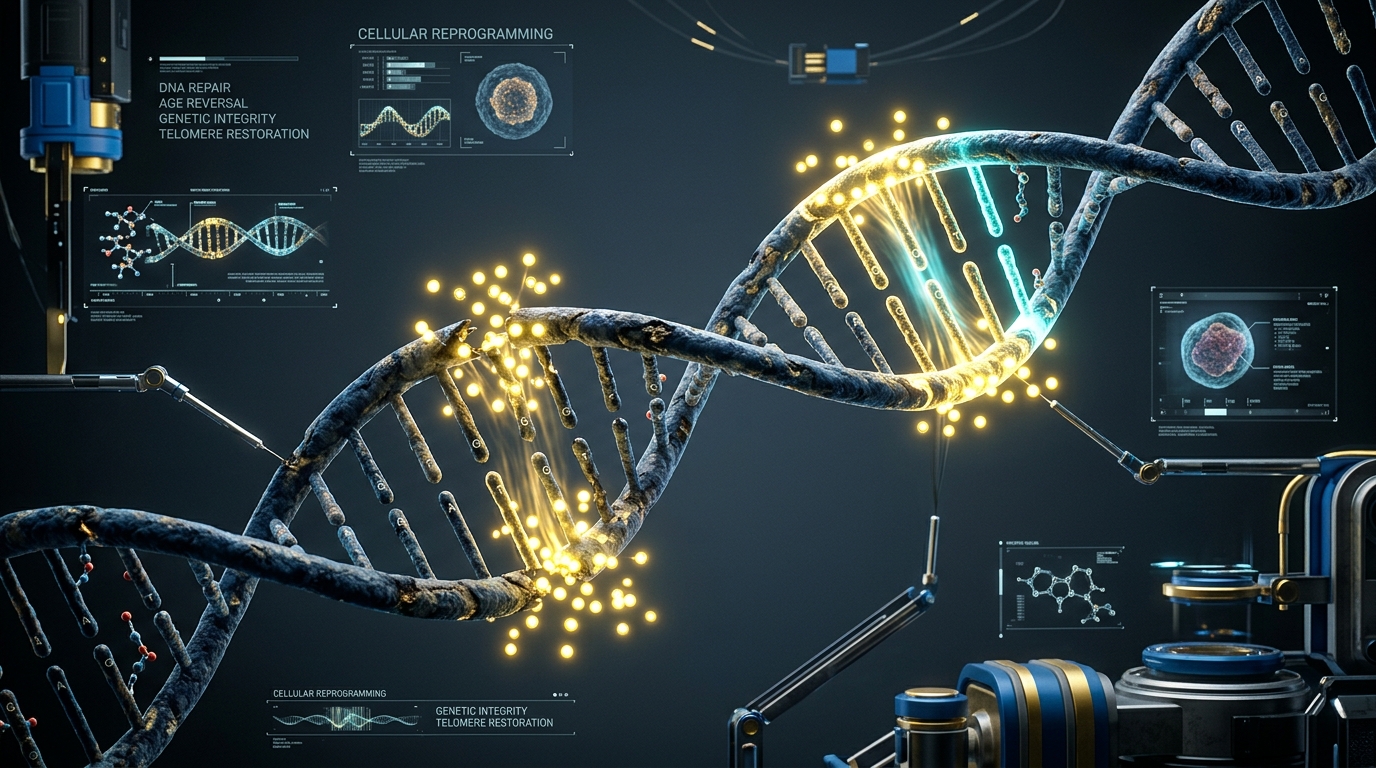
Reverse Biological Aging, Yamanaka Factors, and Longevity Arithmetic: Can We Decouple Cellular Epigenetic Clocks from Chronological Passage?
When we calculate our age using an online Chronological Age Calculator, we are performing a basic, non-negotiable physical tally. We subtract our birthdate from today's date. The result is an integer representing how many times we, as a collection of atoms, have completed a $940\text{ million-kilometer}$ orbital lap around the Sun.
This chronological tally is mathematically rigid, linear, and completely indifferent to our health, lifestyle, or biology. Time, in the classical macroscopic world, ticks forward at exactly one second per second.
But inside your body, another clock is ticking—one that is highly dynamic, non-linear, and incredibly malleable. This is your biological clock, which measures the actual physiological wear, tear, and decay of your cells, tissues, and organs.
For the entire history of life on Earth, these two clocks have been tightly coupled. As chronological time passed, biological aging followed in lockstep.
However, in the last two decades, a revolutionary paradigm shift has occurred in the field of biogerontology. With the discovery of Yamanaka Transcription Factors and the development of mathematical Epigenetic Aging Clocks, scientists have achieved what was once considered scientifically impossible: they have decoupled biological age from chronological age, demonstrating that the biological clock of a living cell can not only be slowed down but completely reversed.
In this deep, highly detailed scientific dive, we will explore the biomathematical structures of epigenetic aging clocks, the cellular biology of Yamanaka reprogramming, the latest clinical trials attempting to roll back the biological age of human organs, and the mathematical implications of living in a world where biological age is decoupled from calendar years.
The Universal Truth of Cellular Entropy
Before we examine the molecular biology, we must reflect on a fundamental, universal truth of living systems:
"The laws of thermodynamics dictate that entropy in a closed system must always increase—yet a living cell is an open system capable of drawing energy from its environment to repair, restore, and rewrite its own genetic software."
Aging, at its core, is the loss of information. Rejuvenation is the process of retrieving and restoring that lost software configuration.
Part I: The Informational Theory of Aging
To understand how we can reverse biological aging, we must first understand what aging actually is.
For decades, the dominant theory was that aging was caused by the random, slow accumulation of DNA mutations—physical damage to our genetic blueprint. While mutations certainly occur, modern biogerontology is converging on a different, more profound explanation: The Informational Theory of Aging, popularized by Harvard geneticist Dr. David Sinclair.
This theory suggests that aging is not a loss of our genetic hardware (the DNA sequence), but rather a loss of our epigenetic software (the program that decides which genes are turned on or off).
The CD Analogy of the Genome
- The Genome (DNA): Think of your DNA as a digital CD. It contains all the songs (genes) necessary to build and maintain every cell in your body. Every cell contains the exact same CD.
- The Epigenome: Think of the epigenome as the CD player's laser. To play a track, the laser must read the CD. In a skin cell, the laser reads the "skin cell songs" and turns off the "brain cell songs." In a liver cell, it does the opposite.
- Epigenetic Noise (Aging): Over time, as our cells division cycles repeat and encounter environmental stresses, the surface of the CD gets scratched. The laser skips. It can no longer read the tracks clearly. The cell loses its identity; skin cells forget how to act like skin cells, and liver cells lose their physiological precision. This scratch-induced loss of identity is aging.
Reversing biological aging is the equivalent of polishing the scratches off the CD so the laser can read the original, youthful genetic songs once again.
Part II: Yamanaka Factors and the Science of Cellular Reprogramming
In 2006, Japanese researcher Dr. Shinya Yamanaka made a discovery that would win him the Nobel Prize in Physiology or Medicine. He proved that it was possible to take a fully mature, specialized adult cell (like a skin fibroblast) and reverse its biological clock all the way back to an embryonic state.
He achieved this by introducing just four specific proteins, now known as Yamanaka Factors (OSKM):
- Oct4 (Pou5f1)
- Sox2
- Klf4
- c-Myc
These four transcription factors act as a master software reset button. When expressed inside an adult cell, they strip away the accumulated epigenetic "scratches" (the methylation tags on DNA), returning the cell to an Induced Pluripotent Stem Cell (iPSC) state. At this point, the cell's biological age is reset to zero.
Partial Reprogramming: The Fountain of Youth
While resetting adult cells to embryonic stem cells is a massive breakthrough, we cannot do this directly inside a living human body. If we expressed the OSKM factors continuously, our cells would lose their structural identity, divide uncontrollably, and form mass tumors called teratomas.
The breakthrough solution is Partial Reprogramming (or transient reprogramming).
By turning on the Yamanaka factors for just a brief, controlled period (e.g., several days instead of weeks), scientists can strip away the epigenetic noise and restore the youthful methylation pattern without stripping away the cell's physical identity.
In pre-clinical mouse trials, partial reprogramming has successfully: * Restored vision in blind mice by rejuvenating optic nerve cells. * Extended the lifespans of prematurely aging mice by up to 30%. * Rejuvenated muscular tissue, liver structures, and kidney functions.
Part III: The Math of Epigenetic Aging Clocks
To prove that we are reversing biological aging, we must have a reliable, mathematically rigorous way to measure it. This was achieved by Dr. Steve Horvath of UCLA in 2013, who developed the world's first Epigenetic Aging Clock.
The Horvath clock uses machine learning to analyze the methylation status of specific sites along our DNA called CpG islands.
The Mathematics of Methylation
DNA methylation involves the attachment of a small chemical group—a methyl group ($-\text{CH}_3$)—to a cytosine base in the DNA sequence.
By measuring the methylation fraction ($\beta$-value) at specific CpG sites, we can determine how old a tissue is:
$$\beta_i = \frac{\text{Intensity of Methylated Signal}}{\text{Intensity of Methylated Signal} + \text{Intensity of Unmethylated Signal} + 100}$$
Where $\beta_i$ ranges from $0$ (completely unmethylated) to $1$ (completely methylated).
Horvath analyzed data from thousands of human tissues and selected 353 specific CpG sites that correlate with age across almost every organ in the body. The mathematical model applies a penalized regression model (Elastic Net regression) to compute the Epigenetic Age (DNAmAge):
$$\text{DNAmAge} = F left( \beta_0 + sum_{i=1}^{353} w_i \beta_i \right)$$
Where: * $\beta_i$ is the methylation level at CpG site $i$. * $w_i$ is the mathematically weighted coefficient for that site. * $F$ is a non-linear transformation function that accounts for the rapid development phase during childhood.
When this math is applied to a blood sample or saliva sample, it can determine your biological age with an accuracy of within $pm 3.6\text{ years}$—making it the most precise biomarker of aging ever developed.
Part IV: Epigenetic Aging Clocks Comparison
Since Horvath's original 2013 discovery, biogerontologists have developed several generations of epigenetic clocks, each optimized for different biological parameters:
| Epigenetic Clock Name | Launch Year | Number of CpG Sites | Primary Predictive Focus | Biological Precision Metric | Clinical Use Case | | :--- | :--- | :--- | :--- | :--- | :--- | | Horvath Multi-Tissue | 2013 | 353 | Chronological age tracking across all organs | $pm 3.6$ Years | Baseline age verification | | Hannum Clock | 2013 | 71 | Chronological age tracking in whole blood | $pm 4.9$ Years | Blood-specific aging research | | PhenoAge | 2018 | 513 | Phenotypic health biomarkers and mortality risk | $pm 2.2$ Years | Functional aging and healthspan prediction | | GrimAge | 2019 | 1030 | DNA methylation markers of plasma proteins, smoking pack-years | Highly correlated with mortality and remaining lifespan | Outstanding clinical trial tracking of therapeutic longevity interventions | | DunedinPACE | 2022 | 173 | The pace of biological aging (speedometer) | Accurate down to real-time weekly metabolic rates | Measuring immediate effects of diet, stress, and lifestyle modifications |
DNA Methylation vs. Chronological Aging Trajectories
Comparing standard astronomical baseline with optimized biological longevity and accelerated stress curves.
Part V: Decoupling the Clocks: A Life of Dual Ages
As clinical trials of partial reprogramming and longevity therapies enter the human arena, we are about to enter a historical epoch where individuals live with two completely different age metrics:
- Your Calendar (Chronological) Age: The rigid, ever-increasing tally of your solar orbits.
- Your Cellular (Biological) Age: The malleable, biological age of your epigenetic clock.
Consider a person born in 1980. In the year 2040, their chronological age is exactly 60 years.
However, thanks to a regimen of transient epigenetic reprogramming therapies, sirtuin activators, senolytic drugs, and optimized lifestyle practices, their epigenetic GrimAge clock registers at exactly 40 years.
This individual is physically, immunologically, and metabolically indistinguishable from a healthy 40-year-old. Their cardiovascular system is supple, their muscular density is robust, and their cognitive processing speeds are pristine.
Yet, on paper, they are 60.
This decoupling raises profound philosophical, economic, and medical questions: * Retirement Metrics: Should retirement and pension systems be tied to a rigid chronological date, or to an individual's actual physiological biological age? * Medical Care: Should pediatric and geriatric medical parameters be adjusted dynamically, much like the pediatric corrections used for premature infants explored in The Science of Pediatric Corrections? * Insurance Underwriting: Will life insurance algorithms shift from tracking calendar birth years to reading real-time DNA methylation rates using second-generation epigenetic clocks?
Part VI: Practical Longevity Math: Slowing the Clock Today
While full-scale Yamanaka gene therapy is still undergoing clinical optimization, biogerontology research has shown that simple, targeted lifestyle interventions can dramatically slow down—and even briefly reverse—our biological pace of aging.
In a landmark 2021 clinical trial published by Dr. Kara Fitzgerald, a cohort of healthy adult men participated in an 8-week program consisting of a nutrient-dense diet, optimized sleep, mild exercise, and probiotic supplementation.
The results were mathematically stunning: the intervention group reduced their biological age by an average of 3.23 years relative to the control group in just two months!
The Longevity Equation: Maximizing Healthspan
To optimize your rate of biological aging, scientists recommend activating your body's innate survival pathways (also known as sirtuins and AMPK pathways) through three main triggers:
- Nutrient Deprivation (Caloric Restriction): Intermittent fasting or caloric restriction tricks the body into defense mode, pausing cellular division to focus on cellular repair and autophagy (cleaning out damaged organelles).
- Temperature Stress: Exposure to saunas (heat shock proteins) and cold plunges (cold shock proteins) stimulates cellular resilience and improves metabolic parameters.
- Physical Activity (High-Intensity Interval Training): Deep physical exertion stimulates mitochondrial biogenesis, prompting your cells to generate more energy factories.
As the legendary biogerontologist Dr. Steve Horvath famously stated:
"The epigenetic clock is a mirror of our biology, but for the first time in scientific history, we have found the knobs to turn the hands of that mirror backward."
Our online Chronological Age Calculator tracks your journey around the Sun, but your daily choices write the mathematical equations of your physical vitality. By understanding the science of epigenetic reprogramming, we can live lives where our biological clocks tick in a beautiful, slow harmony with the celestial passage of calendar time.