Soli-Lunar Cycles, Metonic Alignment, and Chronological Calendars: Demystifying the Math Behind Lunar and Solar Timekeepers
Soli-Lunar Cycles, Metonic Alignment, and Chronological Calendars: Demystifying the Math Behind Lunar and Solar Timekeepers
When we utilize our digital Chronological Age Calculator to compute our age, we are almost certainly calculating it in the standard Gregorian calendar system. We input a Gregorian birth date, and the software compares it to the current Gregorian date. We receive a neat result in years, months, and days.
But for millions of people around the world, this is only one of many active temporal frameworks. Under the Islamic (Hijri) Calendar, your age is completely different because the year is shorter. Under the Hebrew Calendar or the traditional Chinese Calendar, your age is calculated using a complex, elegant synthesis of both solar cycles and lunar phases—an ancient mathematical discipline known as a Soli-Lunar Calendar.
The celestial dance of the Sun and the Moon is one of the most beautiful sights in the night sky. However, for calendar makers throughout history, it has been a source of infinite mathematical torment.
The Moon and the Sun are two independent clocks ticking at different speeds. Attempting to harmonize them into a single, cohesive calendar is one of the greatest computational triumphs of human civilization.
In this comprehensive exploration, we will dive deep into the astronomical cycles of the Sun and Moon, analyze the brilliant mathematics of the Metonic Cycle, compare how solar and lunar systems compute human chronological age, and demonstrate how modern programmers write algorithms to translate dates across these ancient calendar grids.
The Universal Truth of Soli-Lunar Time
Before we dissect the orbital math, we must reflect on a universal truth that underpins all civil calendar structures:
"The moon and the sun carry out entirely independent celestial dances, yet human ingenuity has woven them together into calendars of astonishing mathematical elegance."
Whether we look to the sky for agricultural timing, religious observance, or personal milestones, we are participating in a multi-layered astronomical tapestry.
Part I: The Fundamental Astronomical Discrepancy
To appreciate why calendar math is so complex, we must first look at the orbital frequencies of the Earth-Moon-Sun system.
1. The Solar Cycle: The Tropical Year
As explored in our historical analysis of Leap Years, Gregorian Reforms, and Atomic Time Precision, the Earth completes one revolution around the Sun (measured from vernal equinox to vernal equinox) in exactly:
$$\text{Tropical Year} = 365.24219\text{ Days}$$
This solar cycle is what drives the physical seasons—spring, summer, autumn, and winter.
2. The Lunar Cycle: The Synodic Month
The Moon completes one orbit around the Earth relative to the background stars in about 27.3 days (the sidereal month). However, because the Earth is also moving around the Sun during that time, the Moon must travel a bit further to return to the same phase (e.g., from new moon to new moon). This cycle is known as the Synodic Month (or lunation):
$$\text{Synodic Month} = 29.53059\text{ Days}$$
3. The Mathematical Clash
A pure lunar calendar consisting of 12 synodic months contains:
$$12 \times 29.53059\text{ Days} = 354.36708\text{ Days}$$
This is 10.87511 days shorter than a solar tropical year.
If we maintain a pure lunar calendar (like the Islamic Hijri calendar), the seasons will drift backward through the calendar year. Ramadan, the holy month of fasting, moves backward through the solar year by about 11 days every year, rotating through spring, winter, autumn, and summer over a cycle of roughly 33 solar years.
For civilizations that require seasonal tracking for agricultural planting, a pure lunar calendar is insufficient. Yet, the lunar phases are highly visible, easy to count, and culturally intuitive. To solve this, ancient astronomers created soli-lunar calendars that use the synodic month as the basic month unit, but periodically insert an extra, 13th month (an intercalary month) to realign the calendar with the solar year.
Part II: The Metonic Cycle: The Astronomical Key
How do we know when to insert this 13th intercalary month? The answer lies in one of the most astonishing mathematical harmonics in our Solar System: the Metonic Cycle.
Discovered (or popularized) by the Greek astronomer Meton of Athens in 432 BC (though known earlier to Babylonian astronomers), the Metonic Cycle is the realization that:
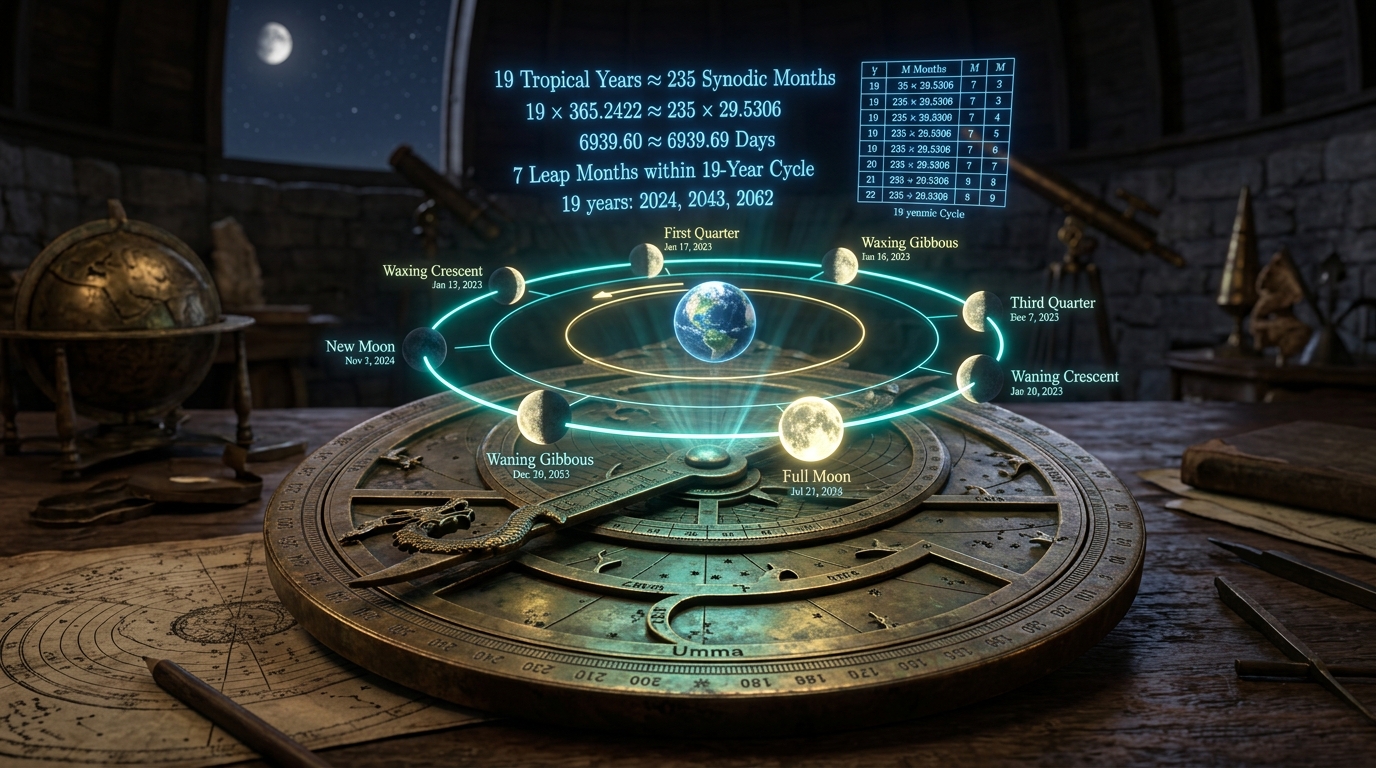
19 Tropical Years are almost exactly equal to 235 Synodic Months.
Let us look at the mathematics behind this beautiful resonance:
$$\text{19 Tropical Years} = 19 \times 365.24219\text{ Days} = 6939.6016\text{ Days}$$
$$\text{235 Synodic Months} = 235 \times 29.53059\text{ Days} = 6939.6887\text{ Days}$$
The difference between 19 solar years and 235 lunar months is a mere 0.0871 days—only about 2 hours and 5 minutes!
This means that if a full moon occurs on your birthday today, it will occur on your birthday again in exactly 19 years, with near-perfect astronomical precision.
The 19-Year Intercalation Pattern
To distribute 235 months over 19 years, we must have: * 12 years consisting of 12 months (ordinary years). * 7 years consisting of 13 months (leap or embolismic years).
$$12 \times 12 + 7 \times 13 = 144 + 91 = 235\text{ Months}$$
In Hebrew calendar math, these 7 intercalary months (called Adar I or Adar II) are added in a repeating 19-year cycle, specifically in the following years: $$\text{Leap Years} = {3, 6, 8, 11, 14, 17, 19}$$
By inserting the extra month in these specific years, the calendar remains in near-perfect synchronization with both the phases of the Moon and the seasonal journey of the Sun.
Part III: Comparative Chronological Calculations: Lunar vs. Solar Age
Because different calendars structure their years differently, calculating your chronological age can yield vastly different numbers depending on which calendar framework you choose.
Let us compare how a person's age is calculated across different calendar networks over a human lifetime:
| Biological Earth Years | Gregorian Age (Solar) | Islamic Hijri Age (Pure Lunar) | Hebrew Age (Soli-Lunar) | Chinese Zodiac Cycle Alignment | Elapsed SI Atomic Days | | :--- | :--- | :--- | :--- | :--- | :--- | | 0.00 Years | 0 Years, 0 Months | 0 Years, 0 Months | 0 Years, 0 Months | Baseline (Birth) | 0 Days | | 19.00 Years | 19 Years, 0 Months | 19 Years, 7 Months | 19 Years, 0 Months | 1 Full Zodiac + 7 Years | 6,939.6 Days | | 38.00 Years | 38 Years, 0 Months | 39 Years, 2 Months | 38 Years, 0 Months | 3 Full Zodiacs + 2 Years | 13,879.2 Days | | 57.00 Years | 57 Years, 0 Months | 58 Years, 9 Months | 57 Years, 0 Months | 4 Full Zodiacs + 9 Years | 20,818.8 Days | | 76.00 Years | 76 Years, 0 Months | 78 Years, 4 Months | 76 Years, 0 Months | 6 Full Zodiacs + 4 Years | 27,758.4 Days |
The Islamic Hijri Age Expansion
If you celebrate your 50th birthday according to the Gregorian calendar: 1. Your total elapsed days are approximately $50 \times 365.2425 approx 18,262\text{ Days}$. 2. In the pure lunar Hijri calendar, the average year is only 354.367 days. 3. We divide your elapsed days by the lunar year:
$$\text{Hijri Age} = \frac{18,262\text{ Days}}{354.367\text{ Days}} approx 51.53\text{ Years}$$
You are over 51 and a half years old in the Islamic Hijri calendar! You have celebrated 51 lunar birthdays, fasted during 51 Ramadans, and your lunar age will continue to drift further ahead of your solar age by roughly 3 years for every century you live.
Astronomical Drift: Calendar Error Accumulation
Drift error accumulation over centuries without modern chronological calibration frameworks.
Part IV: The Chinese Sexagenary Cycle and Staggered Chronology
The traditional Chinese calendar represents another marvel of chronological engineering. It is a soli-lunar calendar, but it embeds dates within a larger, 60-year cycle known as the Sexagenary Cycle (or Ganzhi).
This cycle is formed by the combination of two sequences: 1. The 10 Heavenly Stems: Representing the five elements (Wood, Fire, Earth, Metal, Water) in their Yin and Yang states. 2. The 12 Earthly Branches: Representing the 12 animals of the Chinese Zodiac (Rat, Ox, Tiger, Rabbit, Dragon, Snake, Horse, Goat, Monkey, Rooster, Dog, Pig).
Because the least common multiple of 10 and 12 is 60:
$$\text{LCM}(10, 12) = 60$$
The combinations run in a continuous sequence, returning to the starting stem-branch combination once every 60 years.
The 60th Birthday Milestone (Rebirth)
In Chinese culture, a person’s 60th birthday (called Huan Jia) is celebrated as a monumental milestone. It is the moment their personal life cycle completes a full rotation of the Sexagenary Cycle, returning to the exact stem-branch combination under which they were born.
From a mathematical and chronological perspective, on your 60th birthday, you are starting your second lifetime.
Calculators designed for Eastern cultures must track not only numerical years but also the precise Stem-Branch markers for each year, month, day, and even hour of birth to provide deep astrological and chronological reports.
Part V: Cross-Linking Biological and Calendar Timelines
As we dive deep into these astronomical divisions, it is important to realize that our physical bodies do not read calendars. The cells in your liver, brain, and heart do not care whether you track time using the Gregorian solar rules, the Hijri lunar phases, or the Metonic leap cycles.
Instead, your body tracks time via local physical mechanisms: * Circadian Oscillations: Guided by the master clock in the suprachiasmatic nucleus of the brain, syncing with the daily rise and fall of the Sun. * Epigenetic Drift: Cellular aging recorded by chemical changes in your DNA, as discussed in The DNA Epigenetic Clock: Biological vs. Chronological Timelines.
While a calendar helps us schedule our social, civic, and historical lives, biological markers tell us our true physiological age. The mismatch between these two scales is one of the most exciting areas of modern longevity research.
Part VI: The Algorithmic Translation of Soli-Lunar Dates
To write software like our Chronological Age Calculator that can translate dates across solar, lunar, and soli-lunar systems, developers cannot rely on simple multipliers. They must implement standardized astronomical conversion algorithms.
1. The Hebrew Calendar Algorithm: Gaon’s Derivation
To find the date of the Jewish New Year (Rosh Hashanah) for any year, developers utilize a classic, high-precision mathematical algorithm:
`typescript
function calculateMolad(year: number): { day: number, parts: number } {
// Step 1: Find the number of months since creation
const monthsElapsed = Math.floor((19 year - 18) / 19) 12 +
Math.floor((19 year - 18) % 19 12 / 19);
// Step 2: Multiply by the mean length of a synodic month // 29 days, 12 hours, 793 parts (where 1 hour = 1080 parts) const totalParts = 204 + monthsElapsed * 13753; const totalHours = 5 + monthsElapsed * 12 + Math.floor(totalParts / 1080); const totalDays = 2 + monthsElapsed * 29 + Math.floor(totalHours / 24);
return {
day: totalDays % 7,
parts: totalParts % 1080
};
}
`
This math calculates the exact average astronomical alignment (Molad) of the Moon down to the fraction of a second, demonstrating the incredible mathematical sophistication of ancient cultures.
2. The Chinese Calendar Algorithm: Astronomical Coordinates
Unlike the Hebrew calendar, which uses fixed arithmetic approximations, the modern Chinese calendar is calculated using the actual, physical positions of the Sun and Moon.
The algorithm requires: 1. Astronomical Solar Terms: Dividing the Earth's orbit around the sun into 24 segments (every $15^circ$ of solar longitude). 2. Astronomical New Moons: Calculating the exact moment when the Moon is in conjunction with the Sun.
If a lunar month does not contain a major solar term (such as the solstice or equinox), it is designated as an intercalary month (Run Yue), pushing the rest of the year forward to keep the seasons aligned.
As the legendary polymath Galileo Galilei beautifully wrote:
"The sun, with all those planets revolving around it and dependent on it, can still ripen a bunch of grapes as if it had nothing else in the universe to do."
Our universe is vast, and the celestial rhythms are incredibly complex. By understanding the mathematical mechanics of lunar, solar, and soli-lunar timekeepers, we can appreciate the profound historical and scientific legacy embedded in every simple date calculation.